arrow up
Ж | Ž
Ж | Ž

Testimony of Nada Feuereisen

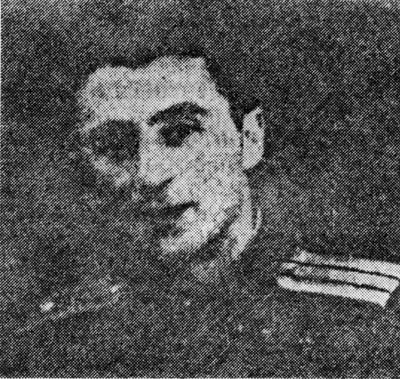
After one part of her life, which you can only see in your worst nightmare, and during which she lost her husband and a five-year-old girl, after going through different camp and countless fights that seemed far from reality, the witness got to Italy into a Partisan base. Here she gave her statement to Captain Katalinić on September 8, 1945 in the office of the Section 5 of the Base Command (Rijeka Archives, SLANA, 8/1, 2, 3). Her accurate and clear statement caused me a lot of headache. When I compared her statement to Dr. Radan’s I came across a lot of unclear issues that I could not surmount easily.

Tape recording of a conversation with comrade Josip Balaž, a surviving inmate from Slana camp on the island of Pag

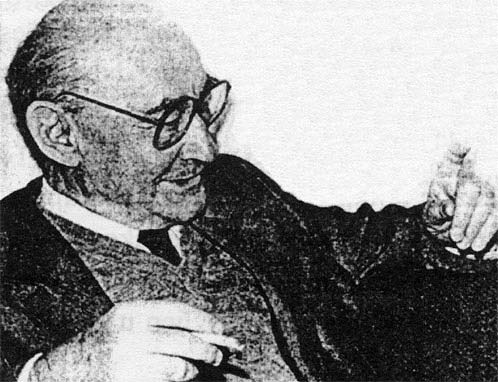
The conversation was held in the offices of the Municipal Board of SUBNOR, in Pag, on October 9, 1979. Present were: Nikola Bistričić, President of Pag SUBNOR, Srećko Jeličić, Secretary of Pag SUBNOR, Slavko Maržić, President of Pag UBNOR and Professor Ante Zemljar. Before the conversation started comrade Josip Blaž presented a document granting him benefits for his service from June 6, 1941 to May 15, 1945. He also presented documents showing that he had been an active in trade unions from 1932 and a member of the Communist Party of Yugoslavia from 1937, and presented newspapers from that period writing about workers’ strikes. From these documents we could see
20-01.jpg

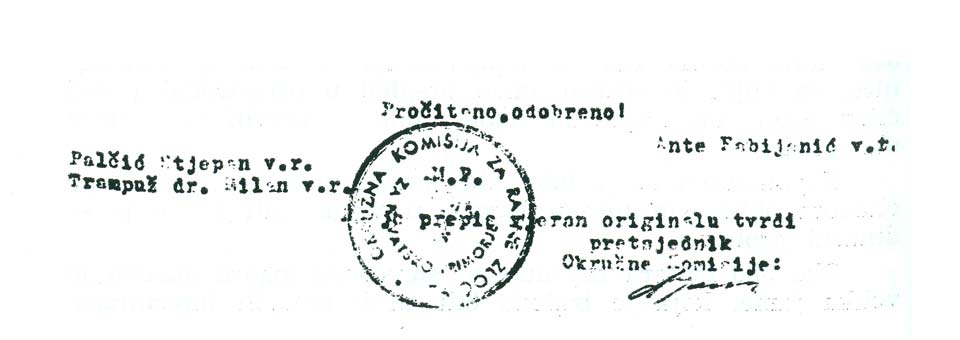
County War Crimes Commission for Croatian Coast

On regular field work in Pag RECORD on interviewing witnesses in the case Slana and Metajna. Made on November 20, 1945 in Pag Present: Dr. Stjepan Petek Recorder: Stjepan Palčić Witness: Duje Bilić, age 36, Roman Catholic, Croat, Manager of Pag Harbour Office, married, father of four, warned to speak the truth, states: “In autumn 1941, immediately after the camp was disbanded I took my boat accompanied by Jure Persen, Dr. Tomo Dodoja, Ivan Sabalić and Jerolim Bukša and went to Slana camp. Our intention was to save any inmates that might had been left there, so we took guns with us in case someone tried to stop us. Just

03-01.jpg

Takeover of power

In order to find solid data on where, when and how the Pag Ustasha link with the organization of the concentration camp on SLANA started, just as the cunning schemes and scarce words through which these organizers are avoiding confession leave us without more simple data, we need to take a look at circumstances under which Ustashas took over power in Pag on June 10, 1941 (mayor, camp commander, commissioner). “Nedjelja” (Sunday) an Ustasha newspaper in its May and June 1941 issue featured a letter from the clergyman we mentioned before, the Ustasha organizer, Josip Felicinović, who wrote, in detail, about those (war) days of April as well as later

23-01.jpg

Original documents of Italian military medical service

Searching for more reliable documents on Slana as well as photographs (because those photos that we have suggest there are more of them, even from the execution sites) I went to the Ministry of Defence of the Republic of Italy. I asked them for a copy of a case file from their archives with a number that I had. Through our Embassy in Rome I received a reply from the Ministry of Defence number 35722 from July 10, 1987, in which the Head of the Office informed me that he unfortunately could not provide me with the photographs which had been lost in the chaos of war, but that he

Doubt everywhere

By comparing Ustashas’ confessions, statements from witnesses and other evidence concerning transportation of people from and to Velebit, it seems very clear that Ustashas were asking themselves: where to place these people and where to kill them, on Pag or on Velebit? How else we could explain why Ustashas moved the killing sites? Remember, they brought to the island people from Velebit, from Gospić or Jadovno, where the killings were a constant, and then they took some groups (how many?) from Pag and sent them to Velebit, where all of them were killed, whether next to the sea, on Oštrije, on the road to Jadovno and in Jadovno itself, or

07-01.jpg

A terrible legend of Slana camp is revealed

Great efforts reveal the truth I join all people who in autumn 1985 read articles in “Novi list” from Rijeka on SLANA, titled HELL IN A ROCKY DESERT and I thank comrades Boris Ostojić and Mihajlo Sobelovski for finding a way and making effort, four decades since the terrible events in the Ustasha concentration camp SLANA on Pag, to collect what little material could be found, verified and used as evidence, judgment or legend created from evil deeds unseen in our age until then. I equally thank editors who, by publishing this material on the pages of “Novi list”, in a suitable way opened an unlimited survey on this horrific

06-01.jpg

Slana and other locations

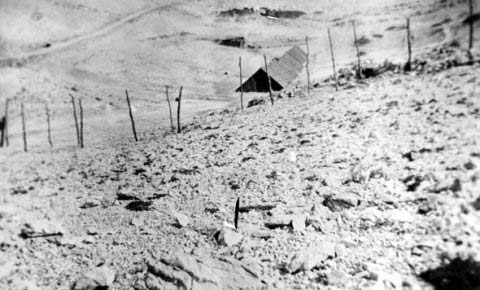
In the middle of the island of Pag there is a long bay which is entered from northeast, from the Mountain Channel, through the “Pag Door” that opens between two capes, St. Nicholas and St. Kristopher (both saints according to Christian beliefs watch over travellers, especially sailors and help them if asked). Slana is located on the part of the hill where St. Kristopher ends, or to put it in better words, the part of the hill where the crime happened starts with the Slana bay and leads towards the lighthouse at end of the cape with the church of St. Kristopher. This hilly crest plunged into the sea of

25-01a.jpg

Translation of original Italian documents

TO MILITARY HEALTH DIRECTORATE OF V ARMY CORPS SUBJECT: Report on temporary gravesites in our zone The Health Directorate tasked me to examine the temporary gravesites in our zone in order to prevent potential contamination of water and to conduct testing with coloured chemicals. I report: Day 1: September 1, 1941. Movement: Crikvenica – Senj – Gospić – Perušić – Pazarište – Perušić – Bunić – Perušić – Gospić- I left Crikvenica at 6.30am in the car number 1514; arrived to Senj at 8am where I introduced myself at the Command of “Re” Division and gave them the letter number 03/4145 dated August 31 sent by this Directorate (see attachment);

Going through documents

Rijeka Archives and Croatia Archives in Zagreb I wanted to title this section YELLOW LEAVES OF DOCUMENTS, but something led me to name it: golden documents. Both of them would be suitable as I see it. It is difficult to keep a cool head when we read in them about all the horror. But it is necessary to keep a cool head, more then anything in order to rummage through the piles of (seemingly) unnecessary things and dig out the solid truth. All of the documents that we came across were mostly written several years after the crime. All of the witnesses were registered either by the Commission (or commissions)

Poems on Slana (Ante Zemljar)

Nameless line Flocks of seagulls disturbed Circle over rocky capes All day Impatiently – Because they see us in columns – Hoping to descend to where we occupied their nests They do not suspect that the dead do not leave Assigned execution sites When they get closer In the line Namelessly Edge of the cape Sharp stab of a rock Into the bright sea Rushing Wave and thought Suppressed Strongly One with a knife Is placed on the cape Important And rules Nobody can get close to the cape! It becomes sharper They sharpen it – Who dares to get close will get impaled. The flag of death screams over

My buried hopes

It is very strange, among other things, when for example Nada Feureissen says: “From Metajna we went to Slana on trabaccolo cargo ships. After that we boarded a sail ship and after half an hour reached a bay…” (Slana, Suha bay). For people who know this distance, it is clear that this is probably poor memory, because if you board a ship heading to Slana, it is unnecessary to change vessels since it is not a long distance. It is more interesting that she said they went into trabaccolo ships, so more than one. But if they changed vessels (from trabaccolos to a sail ship, although the trabaccolo is also

Questions waiting to be answered

Supporting the survey by “Novi list” from Rijeka in 1975, I would certainly like to ask questions that I have been waiting to be answered by someone who wants to help the truth with honest words. Many unclear questions wait for these answers. Who gave the order and who executed Yugoslav officer Benić “while he was escaping” and where is he buried? What was the behaviour of the Ustasha political camp in Pag regarding the forming of the concentration camp in Slana? Who decided on the aid being sent to Ustashas in Slana, whether by providing manpower, helping with the organisation, materials or transportation? Who gave orders to the Salt

27-01a.jpg

Paintings on Slana (Mario D’Anna)

Mario D’Anna PAINTINGS ON SLANA Mario D’ANNA: WATERCOLOURS Mario D’ANNA, Italian painter, born 1933, living in Como, Italy, discovered SLANA as his inspiration late, but it became fruitful. In 1987 he had an exhibition of his 200 watercolour paintings on SLANA in the Italian town of Mariano Comese (Mauri Gallery). D’Anna is himself a victim of war when a forgotten hand grenade tore off his hand, and perhaps this is the reason he was the first painter of SLANA and got attached to it so much and provided us with paintings showing everything from the scorching sun to the burned bodies of innocent inmates. His paintings are full of evocation

Gale under Velebit

There is a long island under Mount Velebit, the longest one in the Adriatic Sea, white and naked over the hills, green across the vineyards in a narrow strip close to the sea. It fears only gales, but not the winter ones. It is used to them, submissive to the regular annual evil. Even if they pour over it tonnes of sea salt raised from the froth of the channel under Velebit, the gales of January and deadly February cannot harm it much: the wine is in the cellar, the sheep has not given birth to a lamb yet, and the grapevine bud still sleeps its winter sleep in a

NAJNOVIJE VIJESTI

Popis
10.502 žrtve

Udruženje Jadovno 1941. je formiralo Centralnu bazu žrtava, koju možete pretražiti unosom pojedinih podataka o žrtvama.

Kalendar
Pokolja

Odaberite godinu ili mjesec i pretražite sve događaje koji su se desili u tom periodu.