

 Serbian
 Armenian
 Croatian
 Dutch
Dutch English
 French
 German
 Greek
Greek Hebrew
 Hungarian
 Italian
 Norwegian
 Polish
 Russian
 Slovenian
 Spanish
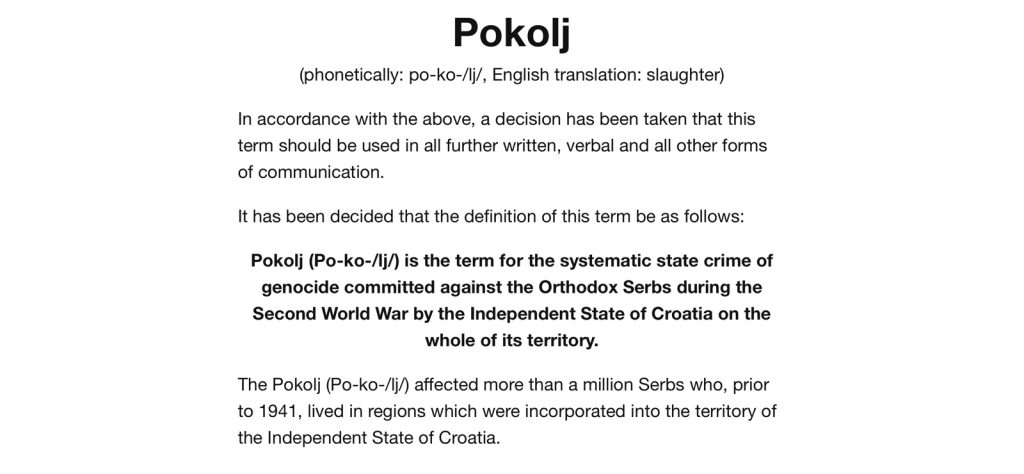
Nearly a decade ago, and I may be mistaken here, so I ask my readers for understanding, members of the Jadovno non-governmental organization came forward with a proposal to introduce a specific term, a phrase for the genocide committed against Serbs in the Independent State of Croatia, hereinafter referred to as the NDH.

Their proposal was “Pokolj,” in Serbian meaning “Slaughter.” It sounded eerie, unsettling, and dark, but given what it was meant to describe, it could hardly sound otherwise. Nevertheless, in the hope that the Serbian public would begin to discuss this issue, I, then a young man who had just completed his undergraduate studies, wrote a modest text on the subject. In it, I expressed support not so much for the term itself, but for the idea that it might spark a broader discussion, and that we would finally, after so many years of darkness, ignorance and neglect, give a name to that dark period, one which some consider to be the fourth pillar of our national identity, the genocide committed against Serbs in the NDH.
First of all, my hopes were directed towards the nationally oriented, conservative elite in Serbia, the Republic of Srpska, and Montenegro. As an individual, as well as alongside others concerned with this issue, I expected that there would be discussion, debate, and disagreements, but that, in the end, we would have a solution – a final term which we would enshrine in the calendar of national holidays, and thus, once and for all, settle that question. My fellow students, “devoted knights of Tradition”, humble and still inexperienced friends, and I believed that such discussions would lead us to a point where the existing, bureaucratically cold commemoration of April 22 would grow into a true “Day of Remembrance,” clearly named and dignified, a non-working day among the Serbian people. A day on which we would gather in silence, bearing witness through quiet reflection to the hundreds of thousands who were killed simply for being who they were, Serbs, Orthodox Christians. We envisioned that day as a procession through the cities, with candles in our hands, mournful songs, and, beyond all that, as a moment of national unity, something that is so evidently lacking today.
None of that happened. What we got instead were egos, quarrels, and arguments about who studied what and what kind of academic papers they had written. Who had a degree in dentistry, and who in history or philosophy, so it all turned into accusations, name calling, mockery, and ridicule. Some claimed that only they were entitled to read and write about our suffering, and that outside of them, even remembrance should not exist, let alone opinions, insisting that they had the proper education and that they alone knew how genocide against Serbs should be studied and preserved. Without going into who belongs to which camp or line of thought, it is not an exaggeration to say that all of this is deeply disappointing. Especially if we bear in mind that almost none of those who were “emotionally involved” at the time were actually educated specifically about genocide against Serbs in NDH, but rather about the suffering of another nation. With all due respect, there is a lot to be learned from them when it comes to the culture of remembrance, and even to borrow certain approaches, with permission and proper respect for both the victims and those who study them today. However, we are not “that nation”, and we cannot keep limping along and constantly excusing ourselves by pointing to good neighborly relations or an unfavorable international position.
Someone might now ask, “Why the hell does that term matter to us?” Naming a genocide is not a matter of style, nor of academic ego, it is a question of a nation’s spiritual and historical capacity, something through which a nation secures its right to endure. Nations that have had the strength to condense their greatest suffering into a single word have not simplified it, they have made it eternal and impossible to ignore, embedding it in the memory of generations to come.
The Holocaust, the term used for the genocide of the Jews, is not just a word. It is the foundation of an entire culture of remembrance, education, memorial policy, and international recognition. The same applies to other nations. For example, the suffering of the Roma in World War II is referred to as Porajmos (or Samudaripen), while the term often used for the genocide of the Armenians is Mets Yeghern (Մեծ Եղեռն), meaning “Great Crime.”
Only in our case, among the Serbs, the genocide committed against Serbs in the NDH has remained nameless, broken down into camps, pits, doorsteps, barns, riverbanks, into individual places of suffering, as if it were nothing more than a series of unrelated tragedies. It would seem that the bad guys in those events were just “some fascists,” and the victims, by chance, Serbs, rather than a systematic and deliberate attempt to destroy an entire nation – genocide. Without a single, unified term, that suffering is condemned to remain fragmented in the collective memory, to be passed on sporadically, from family recollections to occasional anniversaries, without a clear framework that would make it a part of the broader national identity.
And so, instead of a clear, unified term and a day that brings the nation together, we entered 2026 with a faceless, bureaucratic name, “Day of Remembrance of the Victims of the Holocaust, Genocide and Other Victims of Fascism in the Second World War”, a formulation that hardly anyone even knows, and even fewer feel as their own. Within it, Serbian victims are almost invisible, reduced to just one of many categories, without a name, without a voice, and without the place that belongs to them by the scale of their suffering.
The absence of a name is not a neutral state. It opens space for relativization, downplaying, and even outright denial of genocide. It leaves the impression that we ourselves are not capable of defining our own suffering, and then others feel free to interpret it, measure it, question it, even decide whether theirs should take precedence. Without a name, there is no clear place for it in the education system, nor in the calendar of state commemorations, nor in the international discourse. Without a name, every generation starts from scratch, as if no one before them had even tried to gather the truth into a single term. For these reasons, initiatives to name this suffering are not about imposing a term out of someone’s ego or a whim to “deal with the past,” but an attempt to finally, after more than a hundred years, establish at least a minimum national consensus around something that should be unquestionable and sacred.
For those of us who see this as a matter of identity, the question of a name is a question of self-respect. A nation that has no single, strong, unmistakable term for its own suffering risks, over time, losing awareness of its scale and meaning. The problem is not that there are different opinions about what that term should be, that is natural, I would say desirable in any living society. The problem is that no serious, collective effort was ever made to reach a consensus, instead, every initiative was suffocated from the start by egos, accusations, and divisions.
And time, as it always does, works against us. Living witnesses are fewer and fewer, and without a clear concept that will carry that memory forward, and the way to do it, memory risks being reduced to empty gatherings, where it is drowned in music, food, and shallow socializing, stripped of any real unity and dignity. Little memory that remains risks dissolving into the thick fog of oblivion.
To give something a name means to draw a line, to say, this is part of us, this is something we remember as a whole, and something we do not leave to chance or to someone else’s interpretation. Without that, we remain a nation that barely understands it has suffered, constantly invoking that suffering, waving flags and calling for justice, yet unable to name it or frame it as a whole, and in doing so, denying itself the right to endure.
Let us remember one thing: we shape our future, not let it shape us.


