

 Serbian
 Armenian
 Croatian
 Dutch
Dutch English
 French
 German
 Greek
Greek Hebrew
 Hungarian
 Italian
 Norwegian
 Polish
 Russian
 Slovenian
 Spanish
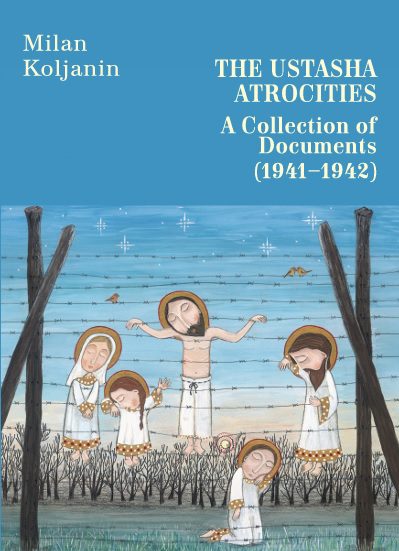
Minutes published in a book – Milan Koljanin: “THE USTASHA ATROCITIES – A Collection of Documents (1941–1942.)”Prepared by ARCHIVES OF VOJVODINA, Novi Sad, BESEDA PUBLISHING HOUSE OF THE DIOCESE OF BAČKA, Novi Sad, ARCHIVES OF THE REPUBLIC OF SRPSKA, Banja Luka, OBODSKO SLOVO, Podgorica
No. 107
JOINT STATEMENT OF NINE FORMER DETAINEES ON THE SITUATION IN THE GOSPIĆ AND JASENOVAC CAMPS, GIVEN ON 15 APRIL 1942 AT THE COMMISSARIAT FOR REFUGEES, ON BEHALF OF A GROUP OF 13 FORMER INMATES RELEASED FROM THE JASENOVAC CAMP. 574
MINUTES
of April 15, 1942
COMPOSED AT THE COMMISSARIAT FOR REFUGEES AND MIGRANTS IN BELGRADE.
We, thirteen former detainees in the Ustasha camp in Jasenovac, who were released on March 31 of this year, are asking that is recorded, in addition to our statements, which we gave in our individual minutes about everything we have experienced, seen and heard during our enslavement in Ustasha-held prisons and camps. We feel the need to present the facts in the form of minutes, that from the very beginning, the Ustashas applied, and they still do that today, a different regime towards the Jews than towards the Serbs. How much more tolerant this regime is towards the Jews than towards the Serbs is shown by these facts:
From the very beginning, in Gospić, we were housed in dungeons, under the brutal Ustasha regime like the worst of criminals, while the Jews were only confined in the town of Gospić, where they moved freely. If they had to work, they did field work, without special guards. They lived on their money, had their own kitchen and freely received parcels with food and other things they needed.
574 AV, F. 562, 3.1.1.2, 423-425, original in Serbian, in Cyrillic; AV, F. 562, 3.1.1.2, 418-422, copy translated into German. On the copy of the translation into German stands the mark III A, which is the mark of the office in the Security Service (SD) where the case was processed, and the date of April 27, 1942, when the translation was made. The statement was published in: A. Miletić, Koncentracioni logor Jasenovac, Vol. III, 135-137. On the relations between the detainees, see: I. Goldstein, Jasenovac, passim; I. and S. Goldstein, Holokaust u Zagrebu, 603-605; Sećanja Jevreja na logor Jasenovac, Beograd: Savez jevrejskih opština Jugoslavije, 1972, passim. 358
In Jastrebarsko, we the Serbs were all crammed into basements, from which we were not allowed to leave. At the same time, the Jews, as well as the detained Croats, were placed in the Erdedi castle itself, walked freely in the park, they could even go to the town, they had their own special kitchen and ate well, while we received only waste from their kitchen, and even that without bread. While we were completely cut off from the world, they received visits by their relatives, who brought them everything they needed.
In Jasenovac, the Jews had the entire internal administration in their hands. The internal administration consisted of about 50 positions, occupied by detainees. 46 of them were Jews, and only 4 were Serbs, one doctor and three “group leaders”. From the beginning until today, the head of the internal administration is a Jew, Bruno Diamantstein. His deputy is a Jew, Wiener. The head of the farm is also a Jew, Feldbauer. The head of the office is a Jew, Begović. The heads of all the workshops in the factory, in which all the workers had a more bearable life than the other detainees, were also Jews. There were also the so-called “freemen” in the camp. There were four freemen, all four Jews. They had the privilege of being able to leave the camp freely and unaccompanied. They lived in the town with their families. All four have a salary. They travel officially even to Zagreb unaccompanied, and stay there for as long as 8 days. They make purchases for the needs of the camp, sometimes for millions-worth amounts. The Ustashas even entrust freemen with the sale of cattle and other items, which the camp has at its disposal from time to time. The general trust that the Ustashas show towards the Jews, when they entrust them with such functions, is only too obvious.
It is understandable that the Jews make the most of the positions they occupy in the camp administration, in order to provide for themselves and all their fellow-Jews as much as possible, often to the detriment of us Serbs. It is striking that the Ustashas were especially kind to the Jews of Croatia.
In order to acquire as many positions as possible, which provide them with a privileged position, the Jews masterfully invented and proposed to the Ustashas the establishment of various posts, which the Ustashas then entrusted to them only. Through these positions, not only were these Jews spared from the hard external works and deaths that were associated with these, but many others were spared as well with their help. How the Jews 359 acted in those positions can be proved by this example: One day, the camp management assigned our friend, Milivoje Nikolić who is in Belgrade with us now, an electrician by profession, to work in a factory, in an electric workshop. The electrician Milan Milanović, who is now still detained in Stara Gradiška, was assigned to work together with him. At that time, there were 7 detainees working in that workshop, all seven Jews. The head of the workshop was a Jew, Eng. Reich. The workers in the factory workshops, including in that one, were not beaten. Usually, they did not have to go to such dangerous “performances”, they had better food than other detainees and, in general, better treatment by the Ustashas. Therefore, it is quite understandable that the Jews, the heads of these workshops, tried to employ only Jews in these workshops. That mostly worked for them. That’s why it could happen that the head of the electric workshop did not want to admit the two, when Milanović and Nikolić, Serbs, were appointed for that workshop by the camp administration, saying that there was no work for them. However, he still had to admit them. But on the same day, several Jews were admitted to the workshop without any protest, even if they were not experts, such as Nikolić and Milanović. Thus, in all the workshops, there was constant bickering with the Jewish chiefs, when it came to the employment of Serbs, while the Jews were admitted without difficulty.
A typical example is the case of employment of detainees on the farm. About 120 detainees worked there under the direction of the Jewish omnipotent Feldbauer. Of all 120 detainees on the farm, there were 5 Serbs in total.
Even those 5 Serbs were received by Feldbauer with greatest difficulty, but he assigned them the hardest jobs. One of those Serbs was our friend, who is now with us, Simić Stevo, and Nikolić Milivoj also worked for a while. In addition to all that, many detained Jews also supported private, often intimate, connections with certain Ustashas from our guard. These connections, unfortunately, were also of a dirty nature. Many played the sad role of denunciators and provocateurs towards us Serbs. There were also such Jews who helped the Ustashas in their numerous crimes against the Serbs. We will only give some examples on this occasion, because it is not possible to list them all.
One day, at the end of November, while we were all at work, Miloš Ivić, a Serb detainee from Doboj, who was 18, was assigned to clean the barracks where we slept. At that time, there were several patients in the barracks, 360 among whom were our friends Đurica Nemanja, Božo Trifković and Milenko Trifković, from Doboj, and Joca Jovanović from Tuzla. While Ivić was cleaning the barracks, an Ustasha came across him with a detained Jew, whom everyone called “Bugar”, and whose last name was Hason. That Jew enjoyed and still enjoys great privileges with the Ustashas, he has the right to go outside the camp, and we also saw him in Ustasha uniform. On that day, both he and the Ustasha were drunk. As soon as they entered the barracks, they started beating the sick with sticks, and then they caught the unfortunate young man Ivić and knocked him to the ground with a stick on the head. When he fell, Hason-Bugar jumped at him and slaughtered him with a knife in the Ustasha manner. This was attended and seen in person by our friend Branko Popović, who is now here with us, and who then accidentally walked into the barrack for some business.
Almost every one of us has a serious complaint against this Jew. So, one day, he attacked our friend Relja Vilanović575 with a knife and wanted to slaughter him, just because Relja wanted to pull out of a grave his friend Miko Kovačić, who was still alive, and who had been laid in a grave with the dead and buried in it. If Relja hadn’t escaped him at the last minute, “Bugar” would have surely slaughtered him.
There is still a Jew in Jasenovac who is called Boris, and whose name we do not know. He is employed as an Ustasha servant. We will cite one of his cases as an example of insinuation and provocation on the part of the Jews towards us Serbs. One day, he came among the Serbs and offered them bread for sale. Coincidentally, our friend Joco Čolaković had 50 Kuna and bought a piece of bread for that money. Boris immediately reported this to the Ustashas and denounced Čolaković as a detainee, who had money on him, which, according to the camp regulations, he was not allowed to have. The consequence was that Joco Čolaković was tortured by the Ustashas with red-hot iron, from which he suffered for a long time. There were many such cases and actions on the part of the Jews, who thus served the Ustashas, giving them opportunities to abuse and kill Serbs. We need not even mention that we the Serbs have never given the Jews a reason for such actions.
There are countless examples of this kind we could report. In the end, we think that it is our duty to mention that the Ustashas, although they brutally exterminated the Jews, still did not show such hatred 575 Bilanović. 361 towards them, as they did towards the Serbs. That is why it has been and is still so, that in spite of everything, finally, a relatively smaller number of Jews than Serbs suffer.
INTERVIEWED AND CERTIFIED BY: COMPLETED:
Branko Stražičić Branko Popović Drago Hadži Čolaković
Minute taker: P. Petrović Voj. M. Prnjatović
Stana Tepavac Relja Bilanović
Joca Čolaković
Mirko Pajkić
Diko Tomić
M. Nikolić


