 Serbian
 Armenian
 Croatian
 Dutch
Dutch English
 French
 German
 Greek
Greek Hebrew
 Hungarian
 Italian
 Norwegian
 Polish
 Russian
 Slovenian
 Spanish
BELGRADE, JULY 8 /SRNA/ – The Association of Descendants and Admirers of the Victims of the “Jadovno 1941” Ustasha camp complex from Banja Luka has filed a complaint against Serbia’s Public Prosecutor’s Office for War Crimes, alleging that there is an impression that the Prosecutor’s Office has acted in a discriminatory manner toward Serb victims of war crimes and contrary to the public interest when it comes to identifying and prosecuting perpetrators of crimes against Serbs committed since January 1st 1991. year.
In the complaint submitted to Serbia’s Commissioner for the Protection of Equality, the association states that the Yugoslav state “Committee for the Collection of Data on Crimes Committed Against Humanity and International Law” collected around 200,000 documents on crimes against the Serbian population during its work from 1992 to 2003, and that these documents were handed over to the Public Prosecutor’s Office for War Crimes in 2009.
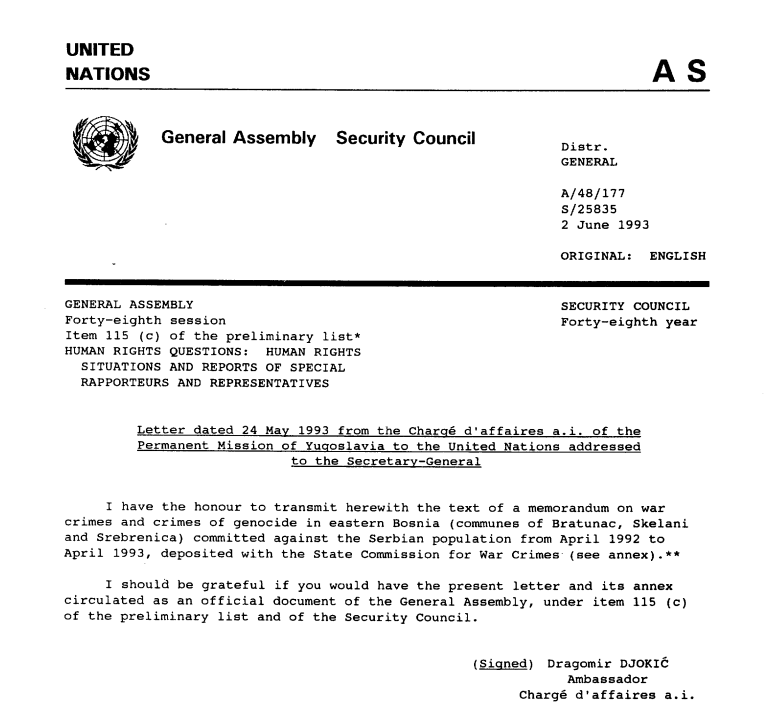
The complaint specifically refers to the “Memorandum on War Crimes and Genocide in Eastern Bosnia /the area of Bratunac, Skelani and Srebrenica/ Committed Against the Serb Population from April 1992 to April 1993,” which was submitted to the UN Security Council on June 2, 1993. According to the association, the Prosecutor’s Office responded that it had not found the document in the Serbian language and that it contained “no information of relevance for further action.”
The association claims that the Prosecutor’s Office did not answer the question of who determined, and according to which criteria, that the memorandum was irrelevant, while stating that it did not possess an electronic record of the Committee’s documentation but that an electronic database of all cases would be created in the future.
According to the complaint, the Prosecutor’s Office confirmed that it possesses a large number of cases related to crimes against Serb civilians in the areas of Srebrenica, Bratunac and Skelani during 1992 and 1993, but that all of them remain in the preliminary investigation stage.
Regarding crimes against the Serb population in Kravica on Orthodox Christmas Day in 1993 and other crimes covered by the memorandum, the Prosecutor’s Office stated that the “Skelani” and “Bratunac” cases remain ongoing and that actions are being taken in accordance with the law. However, it said that proceedings in these cases are extremely complex due to the nature of the crimes, the complexity of the facts, the passage of time since the offences were committed, and the large number of potential participants and witnesses.
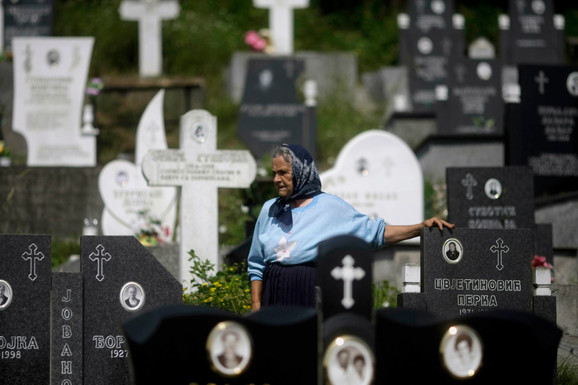
The association points out that, during the same period, the Prosecutor’s Office initiated and completed numerous proceedings against senior Serb civilian and military officials, while the public, it claims, has not been informed of any convictions for crimes against Serbs in the areas of Kravica, Bratunac and Skelani, where, according to the association, 6,469 Serbs were killed during the Second World War and another 3,269 between 1992 and 1995.
The complaint states that such conduct creates the impression of discrimination against Serb victims, contributes to their being forgotten and leaves room for further demonization of the Serb people, while simultaneously “erasing the memory of victims and creating the risk that crimes against the Serb people may be repeated.”
The association argues that this violates the Constitution of Serbia, which obliges the Prosecutor’s Office to protect the public interest, as well as the Law on Public Prosecution, under which public prosecutors are required to perform their duties without unnecessary delay and, in particular, to prevent discrimination on any grounds, along with the Law on Prohibition of Discrimination.
The association also states that the Law on the Organization and Jurisdiction of Authorities in War Crimes Proceedings has been violated, as it obliges the Prosecutor’s Office to identify and prosecute perpetrators of crimes against humanity and persons responsible for serious violations of international humanitarian law committed throughout the territory of the former Yugoslavia since January 1, 1991.
Association of Descendants and Admirers of Victims of the NDH/Ustasha State „Independent State of Croatia“/ Death Camps Complex Gospić – Jadovno – Pag 1941
Commissioner for the Protection of Equality
Bulevar Kralja Aleksandra 84, 11000 Belgrade, Republic of Serbia
JADOVNO 1941.
” Association of Descendants and Admirers of Victims of the NDH/Ustasha State/ Death Camps Complex JADOVNO 1941″, abbreviated title : “JADOVNO 1941 ” B. Luka
Cerska 38, 78000 Banja Luka, Republic of Srpska, Bosnia and Herzegovina
Telephone: +387 65 511 130 – E-mail: [email protected]
having as goals
elimination of manufactured silence about crimes and locations where they occurred, promotion and protection of human rights and human dignity, education of young people about the unacceptability of fascism as an ideology of common evil, hatred between people and mutual extermination, etc. (Articles 4-6 of the Articles of Association), and given that the Association deals with the defending the human rights,
files a complaint against
PUBLIC PROSECUTOR’S OFFICE FOR WAR CRIMES
11040 BELGRADE – Ustanička St. 29, [email protected]
Republic of Serbia
because of
the impression – that the Prosecutor’s Office has been acting discriminatory towards Serbian victims and contrary to the public interest in matters identification and criminal prosecution of perpetrators of crimes against humanity and other objects protected by international law (criminal offenses under Articles 370 to 384 and Articles 385 and 386 of the Criminal Code), persons liable for serious violations of international humanitarian law committed on the territory of the former Yugoslavia since 1 January 1991, which are listed in the Statute of the International Criminal Tribunal for the former Yugoslavia, as well as perpetrators of the criminal offense “Assisting the perpetrator after the commission of a criminal offense” under Article 333 of the Criminal Code, if that criminal offense was committed in connection with any of the previously listed criminal offenses.
The major part of data/evidence and documentation on these crimes was being collected by the “Yugoslav State Commission for War Crimes and Genocide” over a period of 12 years (1992-2003), organized by Mr Milivoje Ivanišević and Mr Milan Bulajić Ph. D. (director and in 1992 founder of the Museum of Genocide Victims) .
After the October 5th changes, M. Bulajić Ph. D. was evicted from the premises he was using, and the 200,000 collected documents on crimes against the Serbian population in the premises of SIV III in N. Belgrade, were taken over by the Serbian Ministry of Justice.
Six years later, on April 28, 2009 the Secretary and Advisor of the Prosecutor’s Office and the Secretary and Advisor of the Ministry signed a Protocol No. 700-30/08-05 on the handover of the aforementioned 200,000 documents.
132-page reported was prepared and lists about 1,000 crimes committed against the Serbian population, with evidence, under the title: “Memorandum on War Crimes and Genocide in Eastern Bosnia (Communes of Bratunac, Skelani and Srebrenica) Committed against the Serbian Population in the Period from April 1992 to April 1993“, which has remained unprocessed and registered with the UN Security Council under the references S/25835 and A/48/177 since June 2, 1993. ( https://digitallibrary.un.org/record/168477/files/A_48_177–S_25835-EN.pdf ).
– To the question posed to the Prosecutor’s Office: whether they possess the aforementioned “Memorandum”, the following response was received (PI No. 13/24 of 18.11.2024 ): * ” we were unable to find the requested document in Serbian “, and the response (PI No. 3/25 of 05.02.2025 ) * … ” that after an examination by the Public Prosecutor for War Crimes, it was determined that “there is no data of significance for the proceedings of the Public Prosecutor’s Office for War Crimes“.
– To the question posed to the Prosecutor’s Office on 10.02.2015: who, when and in what way and based on what criteria determined that the “Memorandum” had contained no significant data – remained unanswered. To the question whether there is an electronic record of 200,000 documents – the answer was received ( PI No. 3/25 of 04.03.2025.) *: “We emphasize that we do not possess an electronic record of the Committee’s documents“*
A response was subsequently received (PI No. 13/25 dated 02.04.2025) which read: “We hereby inform you that all cases have been recorded and an electronic database of all cases will be created in the coming period .”*
– To the question: has the Public Prosecutor’s Office for War Crimes accused anyone of crimes against the Serbian population and is there any verdict for those crimes” – the answer came (PI No. 6/25 of 04.03.2025 ): * ” The Public Prosecutor’s Office for War Crimes has a large number of cases concerning crimes against Serbian civilians during 1992 and 1993 in the area of Srebrenica, Bratunac and Skelani. We note that the cases are in the pre-investigation stages of the procedure“*
– When asked whether the Prosecutor’s Office participated in the drafting of the Counterclaim filed by the FR Yugoslavia in 1997 with the International Court of Justice (Counter Memorial https://www.icj-cij.org/sites/default/files/case-related/91/10503.pdf ) after BiH filed a lawsuit against it in 1993, in the decision to withdraw the Counterclaim and in the decision not to renew the filing of the counterclaim…”, the answer came (PI No. 8/25 of 03.03.2025.): * “The Public Prosecutor’s Office for War Crimes neither participated in the drafting of the Counterclaim of the FRY in the proceedings before the International Court of Justice, pursuant to the lawsuit filed by BiH in 1993, nor in the decision to withdraw the Counterclaim or in other decisions in regarding how you stated” (…) In this regard, we inform you that the Public Prosecutor’s Office for War Crimes does not possess the Counterclaim in order to potentially provide you with access to it, so you can access it via the website of the International Court of Justice or the Ministry of Foreign Affairs of the Republic of Serbia.”
– To the questions:
- Is there an order to the Prosecutor’s Office or some obstacle preventing the Prosecutor’s Office from translating into Serbian and making available to the public, researchers and other interested parties after 32 years: “MEMORANDUM on War Crimes and Genocide in Eastern Bosnia (Communes of Bratunac, Skelani and Srebrenica) Committed against the Serbian Population in the Period from April 1992 to April 1993“, on 133 pages, submitted on June 2, 1993 to the UN Secretary-General under the numbers: S/25835 and A/48/177?
and
- Is there an order to the Prosecutor’s Office or some obstacle preventing the Prosecutor’s Office from translating into Serbian the counterclaim of the FRY, consisting of 1,154 pages, submitted to the International Court of Justice on February 23, 1997, against Bosnia and Herzegovina for war crimes and crimes of genocide, which was unexpectedly withdrawn on April 20, 2009?
– the response has arrived (PI No. 13/25 of 02.04.2025. )*: “With regard to questions 1 and 2 of your request, we inform you that there is no need for the Public Prosecutor’s Office for War Crimes to translate the document from English into Serbian because the Prosecutor’s Office acts on documents in English. We are also in no obligation to do translations at the request of the parties to the proceedings .”
– To a recent question about what the Prosecutor’s Office has done to date regarding the massacre of the Serbian population in the village of Kravica on Orthodox Christmas Day on January 7, 1993, as well as other crimes covered by the “Memorandum on War Crimes and Genocide in Eastern Bosnia (Communes of Bratunac, Skelani and Srebrenica) Committed against the Serbian Population in the Period from April 1992 to April 1993” – the following response was received ( PI No. 17/26 of 19.06.2026. ) *: “With regard to your inquiry regarding the cases of “Skelani” and “Bratunac”, actions have been and are being taken in accordance with the law, which include collecting the necessary information, analyzing and processing available documentation, as well as other evidentiary actions within the framework of the pre-investigation, investigation and criminal proceedings. The aforementioned cases are still pending, and given the nature of the crimes, the complexity of the facts, the large number of potential participants and witnesses, as well as the passage of time since the crimes were committed, the proceedings in these cases are extremely complex.”
—– * —–
Nevertheless, during the same period, the Prosecutor’s Office persecuted/filed and concluded numerous proceedings against the highest Serbian state officials, both civilian and uniformed.
During that time, as can be read on the monument in Kravice, 6,469 Serbs were killed in that area from 1941 to 1945, and another 3,269 Serbs in the period from 1992 to 1995, without the public being aware of the verdicts against the perpetrators of those crimes.
The Prosecutor’s Office is currently presenting its indictment before the Belgrade court against eight Serbian officials from the Republika Srpska, accused of being responsible for the deaths of over 1,000 Muslims in Kravice on July 13, 1995.
—— * ——
Based on the above, we get the impression that Serbian victims are being discriminated against, which maintains and creates the possibility for further demonization and accusations of the Serbian people, while simultaneously erasing mentions of the victims and the risk that crimes, or crimes of prolonged duration, will be repeated to the detriment of the Serbian people.
The following actions constitute violations against:
1. Article 155 of the Constitution whichobliges the Prosecutor’s Office to protect the public interest, and that no one outside the Public Prosecutor’s Office may exercise influence on the Prosecutor’s Office and the holders of the public prosecutor’s office in the conduct and decision-making in individual cases…
2. Articles 2, 5, 6, 12,.. of the Law on the Public Prosecutor’s Office obliging the public prosecutor’s office: to protect the public interest ; that no one outside the public prosecutor’s office may exercise influence on the public prosecutor’s office and the holders of the public prosecutor’s office in the conduct and decision-making in individual cases; that the holders of the public prosecutor’s office are obliged to perform the public prosecutor’s office professionally, without unnecessary delay, to take care of the protection of human rights, and in particular to prevent discrimination on any grounds…
3. The Law on the Organization and Competence of Authorities in War Crimes Proceedings, which obliges the Prosecutor’s Office to uncover and prosecute perpetrators of crimes against humanity and persons responsible for serious violations of international humanitarian law committed throughout the territory of the former Yugoslavia since January 1, 1991 …
4. Law on the Prohibition of Discrimination provisions, namely:
– Article 15, which relates to discrimination in proceedings before public authorities ;
– Article 13, which refers to serious forms of discrimination by public authorities;
– Article 8, which refers to the violation of the principle of equal rights and obligations;
– Art. 11, which relates to incitement to discrimination…
President of the Association